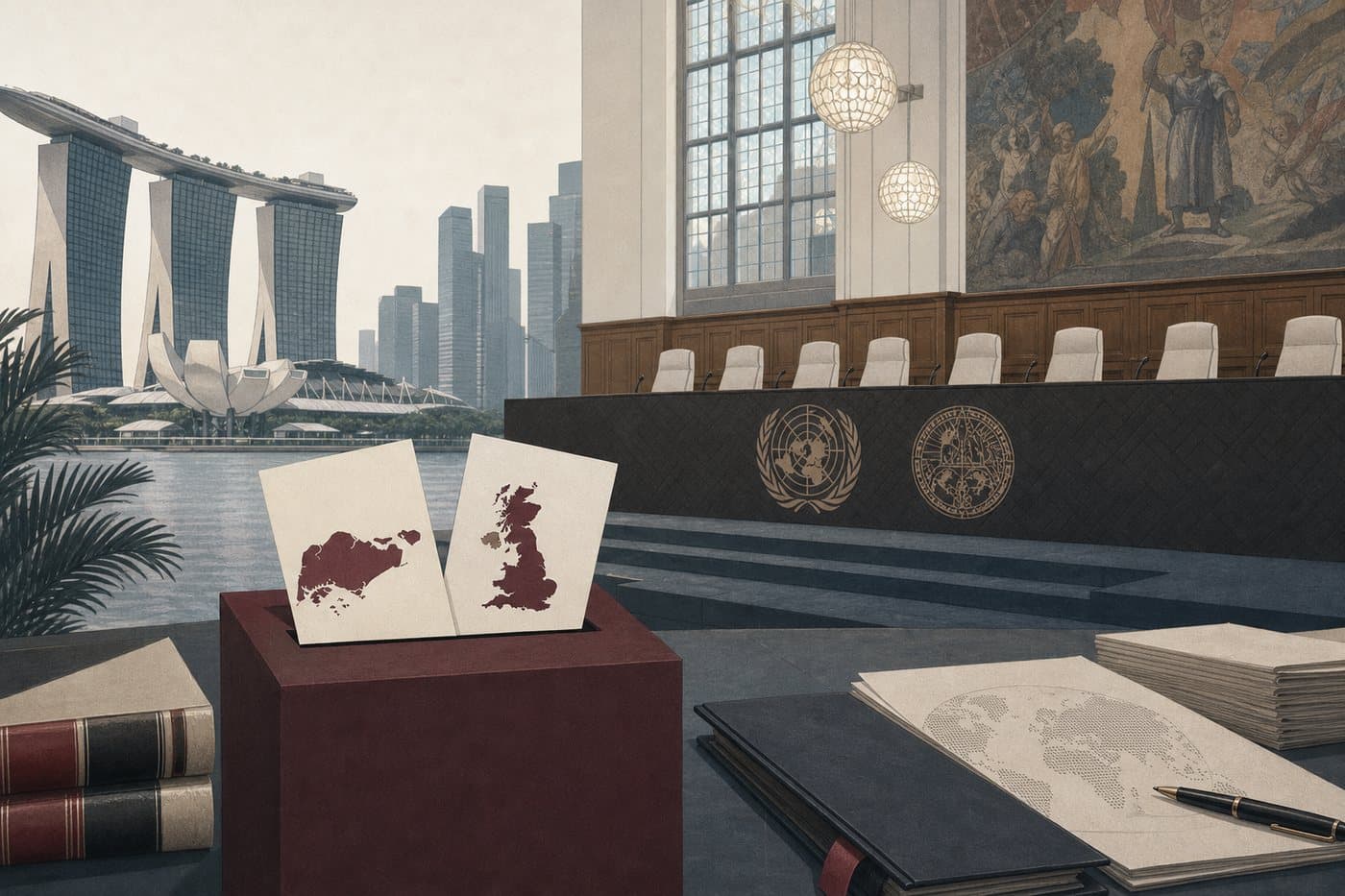
Five judges were elected in the first round at the United Nations on 3 November. Lee is the first Singaporean on the world court and only the second judge from South-east Asia; Akande is the first from the United Kingdom in nearly a decade.
The UN General Assembly and Security Council elected five judges to the International Court of Justice on 3 November, in simultaneous secret ballots at UN headquarters in New York, The Straits Times reports. Singapore's Ambassador for International Law Rena Lee, 57, won in the first round with the highest General Assembly tally, 151 of 191 votes, and the joint highest in the Security Council, 13 of 15. Also elected in the first round were the United Kingdom's Dapo Akande, France's François Alabrune, Kenya's Phoebe Okowa and Jordan's Mahmoud Daifallah Hmoud, from a field of ten candidates.
Lee is the first Singaporean and only the second judge from South-east Asia since the court's founding in 1945; the last, Judge Cesar Bengzon of the Philippines, left the bench in 1976. Her nine-year term runs from 6 February 2027 to 2036. She presided over the UN intergovernmental conference that produced the High Seas Treaty from 2018 to 2023, and holds positions at the Permanent Court of Arbitration and on ICSID's panel of conciliators. Simon Chesterman, David Marshall Professor of Law at the National University of Singapore, noted that she will sit as an independent judge rather than as Singapore's representative. The court has had seven permanent female judges in its 80-year history, against 110 men.
Akande, a professor of public international law at Oxford who first qualified as a lawyer in Nigeria, is the first judge from the United Kingdom elected in nearly a decade, Australasian Lawyer and Canadian Lawyer report. A member of the UN International Law Commission and a fellow of All Souls College, he has appeared as counsel, adviser and expert before the ICJ and other international courts and tribunals. UK prime minister Andy Burnham called the election "a clear signal to our partners that the UK is back on the world stage", and foreign secretary Ed Miliband said the government had supported his campaign. Akande pledged "to serve with independence and to deciding cases on the basis of a faithful and impartial application of the law".